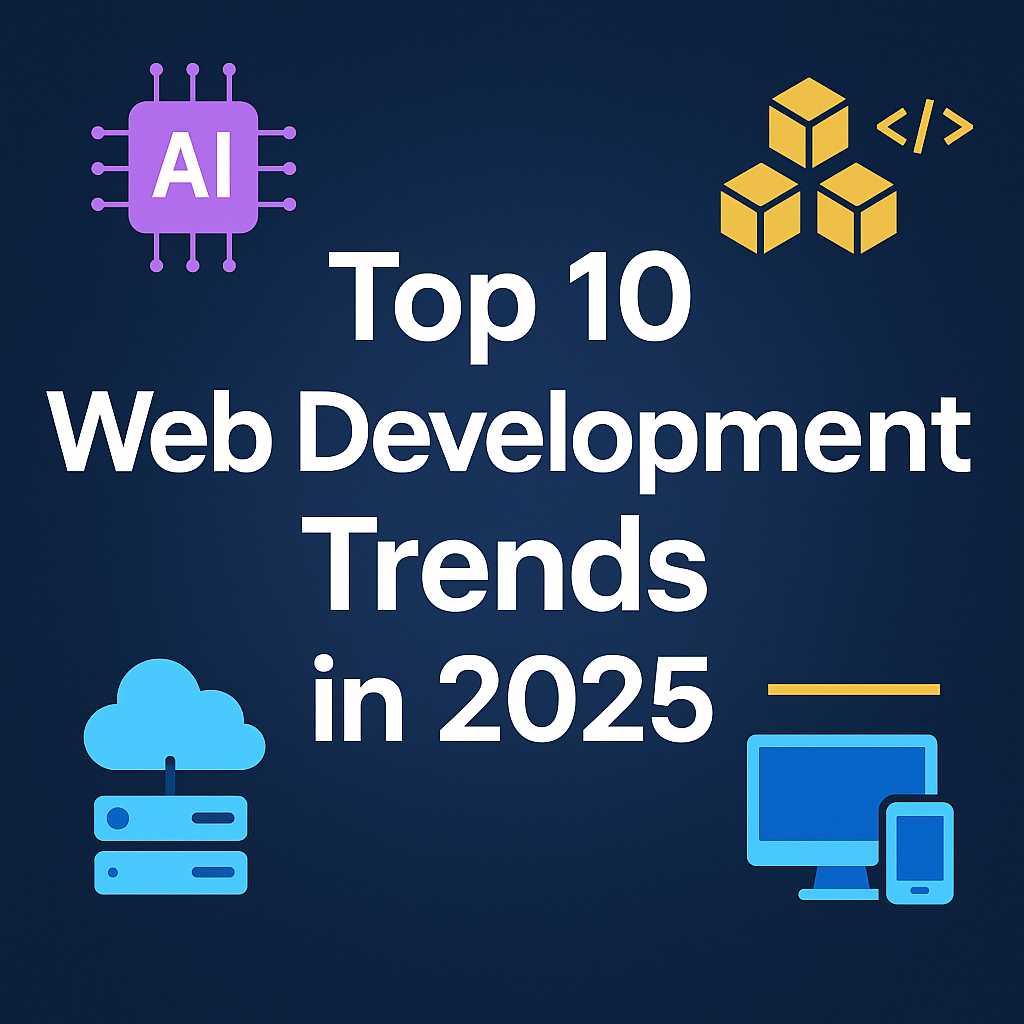
Top 10 Web Development Trends in 2025 Every Developer Should Know
Introduction
The world of web development continues to evolve at lightning speed, and 2025 is no exception. As emerging technologies like AI, Web3, and cloud-native frameworks redefine how developers build and optimize websites, staying ahead of the curve is essential. Whether you’re a frontend enthusiast, a backend expert, or a full-stack developer, understanding the latest trends can help you stay competitive and deliver exceptional digital experiences.
In this blog, we’ll explore the Top 10 Web Development Trends in 2025 that are transforming the digital landscape — with insights, practical examples, and future-ready tools for developers.
1. AI-Powered Web Development
Artificial Intelligence has moved from being a buzzword to an essential part of modern web development. In 2025, AI is not just enhancing user experience but also assisting developers in automating repetitive coding tasks, improving performance, and personalizing content dynamically.
Tools like AI-driven web development assistants can now generate layouts, suggest optimized code, and even detect bugs in real-time. For instance, GitHub Copilot and ChatGPT APIs allow developers to auto-complete functions or refactor code instantly.
Example Use Case:
function generateAIContent(topic) {
  return aiTool.createArticle({ topic, tone: "developer-friendly" });
}
AI-based analytics tools are also helping websites deliver personalized recommendations based on user behavior. Imagine your website automatically adapting layout and messaging to each visitor — that’s the future of dynamic UX.
2. Rise of Progressive Web Apps (PWAs)
Progressive Web Apps continue to dominate the development ecosystem in 2025. With better offline capabilities, faster load times, and mobile-first design, PWAs are bridging the gap between native apps and traditional websites.
Companies like Starbucks and Pinterest have already proven that PWAs can increase engagement while reducing development costs. Developers prefer PWAs for their ease of maintenance, enhanced performance, and improved SEO compatibility.
Why It Matters:
- Instant loading and offline functionality
- Better conversion rates on mobile
- Lower development costs compared to native apps
3. Web3 and Decentralized Applications (dApps)
Web3 is one of the most talked-about web development trends in 2025. Built on blockchain technology, it promotes user ownership, transparency, and security. Developers are now building decentralized applications (dApps) that interact with smart contracts rather than centralized databases.
While still in early adoption stages, Web3 frameworks like Hardhat and Ether.js are empowering developers to build trust-based web experiences. For instance, decentralized identity systems allow users to log in without passwords — using crypto wallets instead.
4. Serverless Architecture
Serverless computing is revolutionizing how developers deploy and scale applications. Instead of managing servers manually, platforms like AWS Lambda, Vercel, and Cloudflare Workers let you focus solely on writing code — while the infrastructure scales automatically.
This trend saves cost, improves scalability, and reduces complexity. Serverless functions also work great with microservices-based architecture, making deployment seamless and modular.
Example:
export const handler = async (event) => {
  const data = await fetchData();
  return { statusCode: 200, body: JSON.stringify(data) };
};
5. Low-Code and No-Code Platforms
As businesses demand faster turnaround times, low-code and no-code platforms are becoming indispensable. Tools like Bubble, Webflow, and OutSystems allow developers (and even non-developers) to build scalable web apps visually, without needing deep coding expertise.
While traditional developers may be skeptical, low-code solutions are ideal for prototyping and MVP development. They enable hybrid workflows — where developers can extend functionality using custom scripts or APIs when needed.
6. API-First Development
With the rise of headless CMS and microservices, the API-first approach is now a standard in 2025. Instead of building monolithic systems, developers are creating modular APIs that power both web and mobile applications seamlessly.
API documentation tools like Swagger and Postman help streamline collaboration between frontend and backend teams. Additionally, frameworks such as Laravel and Node.js make it easy to design RESTful and GraphQL APIs efficiently.
For example, if you're building an application in Laravel, you can test your API with ease using Pest PHP testing tools to ensure smooth functionality.
7. Motion UI and Interactive Design
In 2025, web interfaces are moving beyond static layouts. Motion UI is now a critical component of modern design, helping users navigate websites with smooth transitions and visual cues. Subtle animations can enhance UX without distracting users from content.
With frameworks like Framer Motion and GSAP, developers can create lightweight yet stunning visual effects. These tools also help reduce bounce rates by keeping users engaged longer.
8. Cybersecurity-Focused Development
As cyber threats evolve, developers can no longer treat security as an afterthought. In 2025, cybersecurity-first web development is a leading trend, with teams adopting secure coding practices and zero-trust architecture from day one.
Frameworks now ship with built-in tools for authentication, encryption, and CSRF protection. For example, Laravel provides out-of-the-box middleware for XSS prevention and CSRF tokens, which makes it a great choice for building secure web applications.
Developers are also leveraging AI-based threat detection systems that can identify unusual traffic behavior or potential SQL injection attempts in real time. Modern DevSecOps pipelines ensure that security checks are automated before each deployment.
Key Practices for 2025:
- Implement SSL/TLS and strong password hashing (e.g., bcrypt, Argon2)
- Use Content Security Policy (CSP) headers to prevent XSS
- Regularly update dependencies and third-party libraries
- Adopt AI-driven threat detection tools
Web development in 2025 is not just about creating stunning designs — it’s about building trust through security and data privacy.
9. Cloud-Native Development
Cloud-native applications are dominating web architecture discussions in 2025. With platforms like AWS, Google Cloud, and Azure offering scalable container-based environments, developers can deploy faster and more efficiently than ever before.
Containerization using Docker and orchestration tools like Kubernetes help teams manage microservices seamlessly. This approach allows apps to scale automatically and recover instantly in case of system failures — perfect for high-traffic enterprise systems.
Why Developers Love Cloud-Native:
- Improved scalability and uptime
- Cost-efficient resource management
- Faster CI/CD and automated updates
- Cross-platform deployment flexibility
Modern developers are also exploring “hybrid cloud” models — combining public and private clouds — to achieve both control and scalability.
10. Next-Generation Frameworks and Tools
The web development ecosystem never stops innovating. In 2025, a new wave of next-generation frameworks is emerging, designed for performance, simplicity, and developer productivity.
For front-end development, frameworks like Next.js 15, Qwik, and Solid.js are setting new performance benchmarks. Meanwhile, backend ecosystems like Laravel 11, NestJS, and Deno 2.0 are offering developers cleaner syntax and built-in scalability.
Additionally, the developer toolchain is evolving — from code editors to debugging tools. For example, check out our guide on the Top VS Code Extensions in 2025 to optimize your productivity workflow.
Framework Comparison Snapshot:
| Framework | Type | Highlight Feature |
|---|---|---|
| Next.js 15 | Frontend | Faster builds and server actions |
| Laravel 11 | Backend | Improved queue management and Pest integration |
| Qwik | Frontend | Ultra-fast hydration and lazy loading |
| NestJS | Backend | Built-in microservice architecture |
As frameworks get smarter, developers can focus more on creativity and problem-solving — not just syntax.
Further Reading
- How AI Is Changing Web Development in 2025
- Pest PHP Laravel Developer Guide
- Top VS Code Extensions 2025
- Top AI Tools for Developers 2025
- Best Programming Languages to Learn in 2025
FAQs
1. What is the biggest web development trend in 2025?
The leading trend in 2025 is the integration of AI in web development. From code generation to UX personalization, AI is transforming how developers build and optimize websites.
2. Is Web3 really the future of the internet?
Yes, Web3 and decentralized applications (dApps) are gaining traction. Although mainstream adoption is still growing, Web3 promises transparency, security, and user ownership of data — key elements of the next-generation web.
3. How important are Progressive Web Apps (PWAs) in 2025?
PWAs remain crucial in 2025. They offer the best of both worlds — fast, reliable, and app-like experiences that work offline, without requiring separate native app development.
4. Should developers learn AI or blockchain to stay relevant?
Yes, having knowledge of AI or blockchain will significantly boost your career in 2025. AI-driven tools improve productivity, while blockchain skills prepare developers for emerging decentralized systems.
5. Which framework should I learn in 2025?
It depends on your focus. For frontend, consider Next.js or Qwik. For backend, Laravel 11 and NestJS are top choices due to their flexibility, security, and performance improvements.
Conclusion
The web development landscape in 2025 is defined by innovation, automation, and adaptability. From AI-driven design and serverless architecture to secure, cloud-native ecosystems — the digital future is more connected and intelligent than ever before. Developers who embrace these trends early will lead the way in building next-generation web experiences that are faster, safer, and smarter.
At KnowAdvance.com, our mission is to keep developers ahead of the curve. Keep exploring our latest guides, tutorials, and insights to stay updated with the evolving world of technology and web innovation.