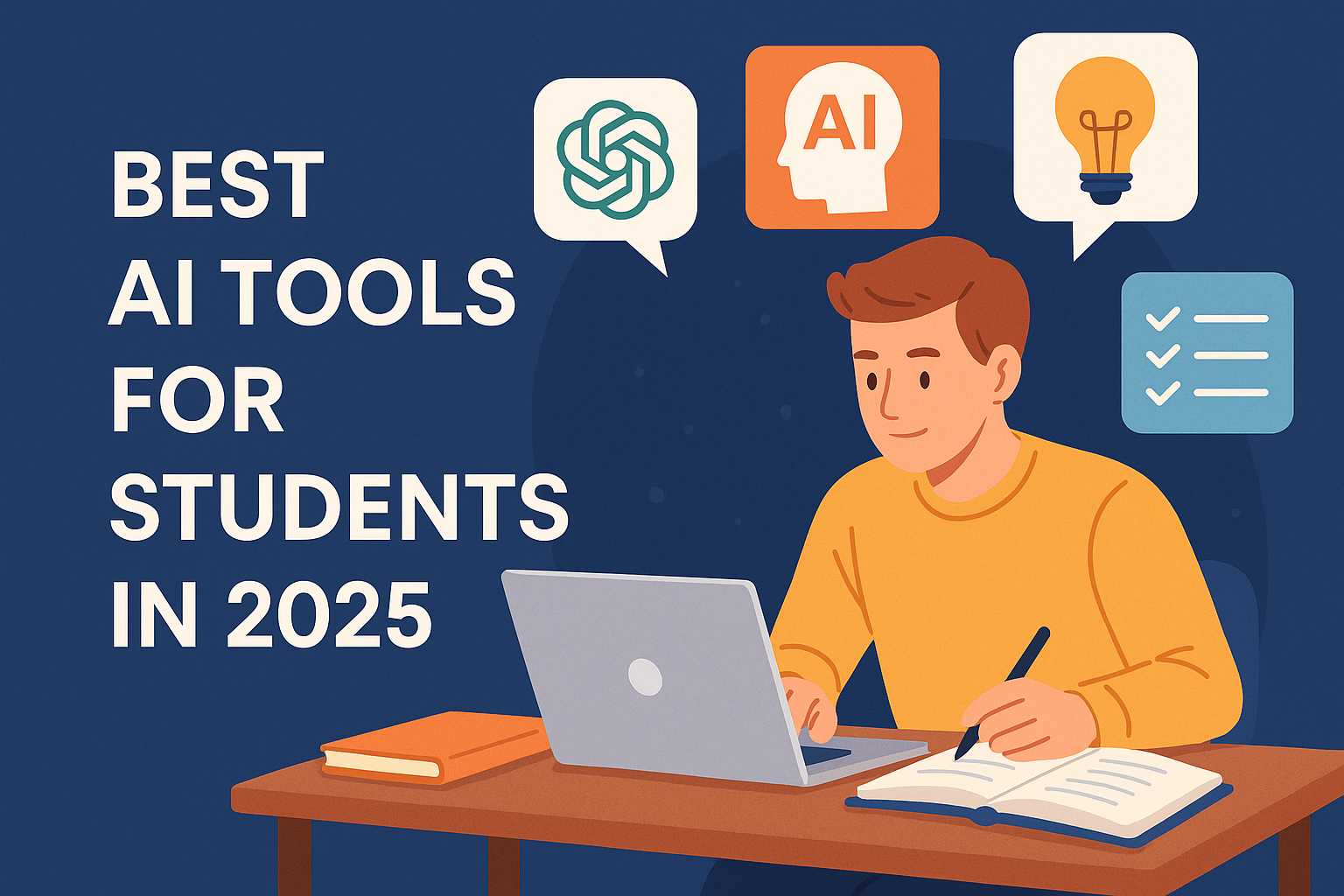
Best AI Tools for Students in 2025: Study Smarter, Not Harder
Introduction
Artificial Intelligence (AI) is transforming the way students learn, study, and manage their academic lives. From writing essays to organizing notes and enhancing productivity, AI tools are making education smarter, faster, and more interactive. In 2025, students have access to an incredible range of AI-powered apps designed to simplify tasks and personalize learning experiences. Whether you're a college student, researcher, or lifelong learner, knowing the best AI tools for students in 2025 can help you stay ahead and make the most of your study time.
What Are AI Tools for Students?
AI tools for students are software applications or online platforms powered by Artificial Intelligence designed to help with academic tasks such as note-taking, research, content generation, studying, and project management. These tools use machine learning, natural language processing (NLP), and data analytics to understand student needs and provide intelligent solutions.
For instance, tools like ChatGPT assist in generating essay drafts, Grammarly improves writing, and Notion AI helps in organizing study notes efficiently. AI has moved beyond simple automation — it now actively enhances creativity, comprehension, and collaboration.
Why AI Tools Matter for Students in 2025
In 2025, digital learning has become the new normal. Hybrid education systems, online degrees, and self-paced learning dominate the academic landscape. AI tools empower students by offering real-time assistance, feedback, and guidance, which were once only available from tutors or peers.
Here are a few reasons why AI tools matter more than ever:
- Personalized Learning: AI adapts to each student’s strengths and weaknesses to provide customized support.
- Time Efficiency: Students can automate repetitive tasks like summarizing notes or proofreading essays.
- Accessibility: AI-powered transcription and translation tools make learning inclusive for all.
- Skill Enhancement: From coding assistants to language models, AI helps students upskill faster.
Simply put, AI tools bridge the gap between traditional education and modern learning needs.
Key Features and Top AI Tools for Students in 2025
1. ChatGPT (by OpenAI)
ChatGPT continues to be a leading AI study assistant. In 2025, it offers improved contextual understanding and multimodal capabilities — meaning students can upload notes, images, or documents and get tailored summaries or explanations.
- Best For: Essay writing, brainstorming, research help.
- Key Features: Context-aware writing, citation assistance, and educational mode for learning concepts.
- Pro Tip: Use ChatGPT to generate outlines before starting a project.
2. Notion AI
Notion AI has become a must-have tool for student productivity in 2025. It helps organize tasks, lecture notes, and group projects — all in one place. The AI assistant summarizes meetings, creates to-do lists, and helps you stay focused.
- Best For: Organizing study materials and project management.
- Key Features: AI-powered summaries, smart notes, and automatic task generation.
- Bonus Tip: Combine Notion AI with Google Calendar for seamless scheduling.
3. GrammarlyGO
GrammarlyGO goes beyond grammar correction — it helps you rewrite sentences, summarize research, and even generate creative ideas. Students in 2025 use it to refine essays, emails, and reports.
- Best For: Essay editing, report writing, and communication.
- Key Features: Contextual rewriting, tone adjustment, and plagiarism detection.
4. Perplexity AI
Perplexity AI is the next-generation AI search engine that combines conversational AI with reliable sources. It helps students find accurate information for assignments, with citations included automatically.
- Best For: Research and fact-checking.
- Key Features: Verified references, real-time web results, and source links.
- Related: How to Make Money Using ChatGPT 2025
5. Quizlet AI
Quizlet’s AI-powered flashcards make studying interactive and personalized. The tool uses adaptive algorithms to identify weak areas and reinforce learning through customized quizzes.
- Best For: Exam preparation and memory retention.
- Key Features: Smart flashcards, personalized learning paths, and voice-based quizzes.
6. Otter.ai
Otter.ai is a transcription and note-taking AI app that automatically records and summarizes lectures or meetings. It’s a game-changer for students attending online classes.
- Best For: Transcribing lectures and meetings.
- Key Features: Live transcription, searchable notes, and collaboration tools.
7. Elicit.org
Elicit.org helps students and researchers find and summarize academic papers. It saves hours of literature review time by analyzing multiple research papers at once.
- Best For: Research paper summaries.
- Key Features: AI literature review, data extraction, and smart citation generation.
8. Canva Magic Write
Canva’s Magic Write is perfect for students who need to create visual projects, presentations, or resumes. In 2025, its AI assistant generates design ideas, slogans, and even study notes in visual form.
- Best For: Presentation design and creative projects.
- Key Features: AI content generator, design templates, and one-click formatting.
- Related: Top AI Chrome Extensions for Productivity 2025
9. Jasper AI
Jasper is a versatile writing assistant that helps students craft essays, research summaries, and blog posts with high readability. Its academic tone settings make it suitable for formal writing tasks.
- Best For: Academic writing and content creation.
- Key Features: Custom tone generation, content templates, and plagiarism-free drafts.
10. Wolfram Alpha
Wolfram Alpha remains one of the most powerful computational AI tools for students in science, engineering, and math fields. It solves complex equations and visualizes data instantly.
- Best For: Math and science problem-solving.
- Key Features: Step-by-step solutions, graph visualizations, and symbolic computation.
Pros and Cons of Using AI Tools for Students
AI tools undoubtedly make studying easier, but it’s important to understand both their benefits and limitations.
Pros
- Enhanced learning experience through personalization.
- Time-saving automation for repetitive academic tasks.
- Improved writing and research accuracy.
- Access to 24/7 assistance and feedback.
Cons
- Overreliance on AI may reduce critical thinking.
- Free versions of tools often have limited features.
- Requires good internet connectivity and digital literacy.
Practical Use Cases of AI Tools for Students
- Note Organization: Use Notion AI to automatically summarize class notes and create study templates.
- Essay Drafting: Combine ChatGPT and GrammarlyGO for error-free, structured essays.
- Research Assistance: Use Perplexity AI and Elicit.org to find credible references.
- Revision Help: Leverage Quizlet AI for adaptive flashcards and spaced repetition.
- Presentation Design: Use Canva Magic Write for AI-generated layouts and content.
Step-by-Step Guide: How to Use AI Tools to Boost Your Studies
AI tools can transform your study workflow, but to get the most out of them, you need to integrate them strategically. Here’s a step-by-step guide for students to maximize learning efficiency using AI:
Step 1: Identify Your Learning Goals
Before choosing an AI tool, define your goals. Do you want to improve your writing, speed up research, or manage projects more efficiently? For example, if your goal is writing improvement, GrammarlyGO and Jasper are perfect choices. For better organization, go with Notion AI.
Step 2: Choose the Right Tool for Each Task
Different AI tools excel in specific tasks:
- Writing: ChatGPT, GrammarlyGO, Jasper
- Research: Perplexity AI, Elicit.org
- Organization: Notion AI, Otter.ai
- Visual Projects: Canva Magic Write
- Math/Science: Wolfram Alpha
Start small — pick two or three tools and master them before adding more.
Step 3: Create a Consistent Workflow
Combine tools to create a smart workflow. For example:
- Use Otter.ai to record lectures and generate transcripts.
- Import summaries into Notion AI for structured note-taking.
- Ask ChatGPT to explain complex concepts in simple terms.
- Polish your assignments using GrammarlyGO.
Step 4: Validate and Cross-Check AI Results
Always verify AI-generated content or answers. Tools like Perplexity AI include citations, but for critical academic work, cross-reference with trusted academic databases or your course materials.
Step 5: Use AI Responsibly
AI should assist you, not replace your critical thinking. Avoid submitting AI-generated essays as your own — instead, use them for brainstorming, structuring, and improving your drafts.
Best Practices for Using AI Tools as a Student
To get consistent results and stay academically ethical, here are some best practices to follow when using AI tools:
- Set clear prompts: AI tools respond best to specific instructions. Example: “Summarize this text in 150 words” gives better output than “Summarize this.”
- Keep your data organized: Store AI-generated notes or summaries in structured folders (like Notion or Google Drive).
- Review and edit AI outputs: AI can make factual or contextual errors. Always proofread the final version.
- Use plagiarism checkers: Ensure originality before submitting any AI-assisted work.
- Stay updated: AI tools evolve fast — explore new features regularly to maintain an edge.
Common Mistakes Students Make with AI Tools
Even though AI tools are powerful, they can be counterproductive if misused. Here are the most common mistakes students should avoid:
- Overdependence on AI: Relying completely on AI for learning can weaken problem-solving and critical thinking skills.
- Ignoring citations: AI tools may miss proper referencing. Always cite your sources manually if required by your institution.
- Using generic prompts: Vague queries produce low-quality results. Always be specific with your instructions.
- Skipping proofreading: AI can’t always detect nuanced grammar or tone errors — always review your content before submission.
- Not customizing settings: Many AI tools allow you to set tone, academic level, or formatting preferences — use them for more accurate results.
Conclusion
AI tools are no longer just futuristic innovations — they’re essential companions in every student’s toolkit. From simplifying assignments to enhancing creativity and managing time efficiently, these tools help students reach their full potential. In 2025, the best AI tools like ChatGPT, Notion AI, GrammarlyGO, and Perplexity AI make learning more dynamic and accessible than ever before.
However, the real power lies in how you use them. Combine the right tools, stay ethical, and continue refining your study process — that’s the key to thriving in the age of AI-powered education.
FAQs
1. Are AI tools allowed for students in schools and universities?
Most institutions allow AI tools for assistance, but not for direct assignment submissions. Always check your school’s policy before using AI for graded work.
2. What are the best free AI tools for students in 2025?
Top free AI tools include ChatGPT (free tier), Notion AI, Grammarly, Quizlet AI, and Otter.ai. These provide powerful features without premium subscriptions.
3. Can AI tools improve academic writing skills?
Yes. Tools like GrammarlyGO and Jasper can refine your grammar, tone, and structure, helping you learn from AI suggestions and become a better writer.
4. Is it safe to use AI tools for note-taking and studying?
Yes, as long as you use trusted platforms with strong privacy policies. Avoid sharing sensitive data or login credentials with third-party tools.
5. What’s the future of AI in education beyond 2025?
By 2030, AI is expected to enable personalized learning environments, adaptive testing, and virtual tutors — making education truly tailored to each student’s pace and goals.