Emerging AI Technologies in 2025: What’s Next for Business & Innovation
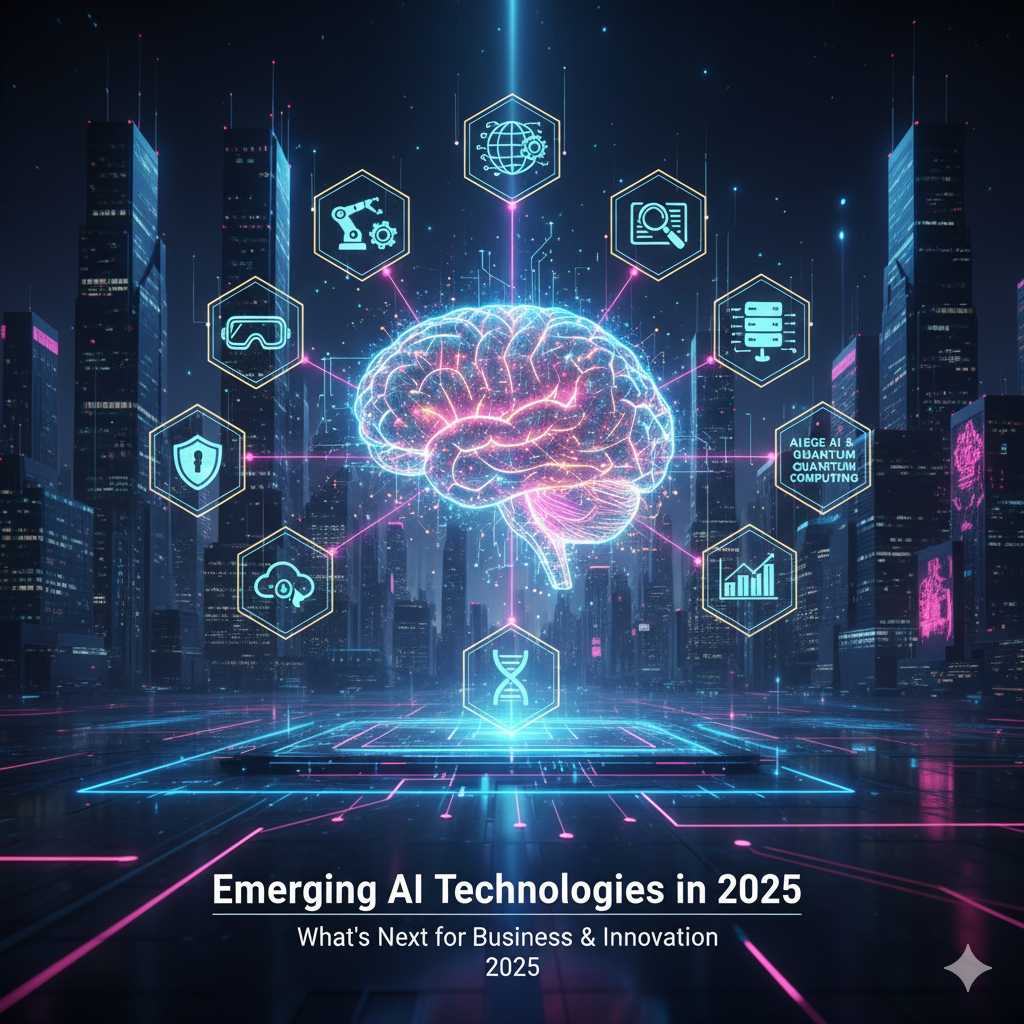
Emerging AI Technologies in 2025: What’s Next for Business & Innovation
Artificial Intelligence (AI) continues to evolve at a pace that’s reshaping how businesses operate, innovate, and compete. As we step into 2025, the world of AI technology is entering a new phase — defined by agentic AI systems, multimodal intelligence, AI-driven automation, and domain-specific models that outperform general AI in precision tasks. Whether you’re a developer, business owner, or digital creator, understanding these AI trends is crucial to stay ahead in a fast-moving digital economy.
In this detailed guide by KnowAdvance, we’ll explore the most impactful AI technologies emerging in 2025, their business applications, ethical challenges, and how you can leverage them to future-proof your strategies.
1. The Evolution of Artificial Intelligence
AI has come a long way from simple rule-based systems to self-learning neural networks capable of reasoning, creativity, and adaptation. In 2024, we witnessed massive breakthroughs in large language models (LLMs) like GPT-5, Gemini 2, Claude 3, and Mistral Mixtral. But 2025 is about refining AI — making it smaller, faster, and smarter.
Companies are now focusing on developing agentic AI — systems that can autonomously plan, act, and learn from feedback without human intervention. Unlike traditional chatbots or assistants, agentic AI systems perform complex workflows end-to-end: from collecting data to making business decisions.
2. The Rise of Agentic AI
One of the biggest AI trends in 2025 is the rise of agentic AI systems. These are self-directed AI agents that can execute goals using contextual understanding, real-time reasoning, and autonomous decision-making.
Agentic AI is transforming industries like:
- Finance: Automating investment strategies and detecting fraud using real-time adaptive logic.
- Healthcare: Managing patient data, scheduling treatments, and predicting outcomes through AI-driven insights.
- Marketing: Generating content, managing ads, and optimizing campaigns without manual input.
- Customer Service: Virtual AI agents that resolve issues, escalate only when needed, and learn from each interaction.
Platforms such as AutoGPT, ChatGPT’s Advanced Agents, and LangChain-powered systems have laid the foundation. In 2025, we’ll see these agents integrated across businesses — automating research, writing reports, coding, and even managing sales operations.
3. Multimodal AI: Understanding Text, Image, Video & Audio Together
Another powerful innovation in 2025 is multimodal AI — models capable of understanding and generating multiple data types simultaneously. Imagine uploading an image, asking a question about it, and receiving both a written and visual answer. This is now reality thanks to technologies like GPT-5 Vision, Gemini 2 Ultra, and Claude Sonnet.
Multimodal systems merge language, visuals, audio, and structured data into a single reasoning engine. Businesses can now use these tools for:
- Product design through text-to-image-to-3D pipelines.
- Customer support using visual diagnostics.
- AI-powered content creation — generating scripts, thumbnails, and captions automatically.
- Medical imaging analysis with contextual reporting.
At KnowAdvance, we track and curate such tools to help users find the most effective AI utilities for text, image, and data automation.
4. Smaller, Specialized AI Models Are Winning
While big models dominate headlines, the real winners of 2025 are smaller, domain-specific models trained on curated data. Known as specialized AI models, they outperform general LLMs in accuracy, cost, and interpretability.
Examples include:
- MedLM for healthcare predictions.
- FinGPT for finance insights.
- LegalGPT for contract and policy analysis.
- CodeGemini for coding and debugging automation.
These models require fewer computational resources, making them ideal for small and medium enterprises (SMEs) who want AI capabilities without heavy infrastructure costs.
5. AI Automation Tools and Workflows
AI automation has become the backbone of modern productivity. From automating marketing emails to generating analytics reports, tools now integrate directly with AI APIs. Businesses are using AI workflow systems to reduce repetitive work and improve decision-making accuracy.
For instance:
- Zapier AI connects workflows across 6000+ apps with smart logic.
- Notion AI summarizes documents and creates task plans.
- n8n + OpenAI enables end-to-end workflow automation.
Our platform, KnowAdvance, offers various online tools like JSON Formatter, Text to PDF Converter, and Image Compressor — all designed to simplify daily digital workflows powered by AI.
6. Generative AI & Creativity Tools
2025 continues the boom of Generative AI — not just for text, but for music, video, and design. AI systems are now capable of creating entire movies, podcasts, and digital art with minimal human input.
Tools like Runway ML, Pika Labs, Synthesia, and Midjourney 6 are pushing the limits of creativity. Meanwhile, AI-generated content is now being integrated with SEO optimization and personalization algorithms, leading to smarter content strategies.
For creators, this means faster production cycles and limitless creative experimentation.
7. AI Ethics, Regulation & Responsible Use
As AI grows more powerful, so do the concerns about privacy, transparency, and bias. Governments across the world, especially the EU and the US, have proposed frameworks for AI ethics and regulation. The EU AI Act, expected to take full effect in 2025, sets clear guidelines for high-risk AI systems and data protection.
Responsible AI development now includes:
- Ethical dataset sourcing
- Transparency in model behavior
- Human-in-the-loop decision systems
- Security against prompt injection and misuse
Businesses implementing AI should prioritize trust and compliance to maintain user confidence and long-term success.
8. The Integration of AI with the Internet of Things (IoT)
The combination of AI and IoT — known as the AIoT — is one of the fastest-growing fields in 2025. Smart sensors, connected cars, and industrial automation systems now rely on AI for real-time analytics and predictive maintenance.
For example, manufacturing units use AIoT to detect machine faults before failure, saving millions in downtime costs. Similarly, smart cities are using AI-powered IoT systems to manage energy consumption, waste disposal, and public safety efficiently.
9. Quantum AI: The Next Frontier
Though still in its early stages, Quantum AI is the next big thing. With quantum computing, AI models can process massive datasets exponentially faster, unlocking breakthroughs in genomics, climate modeling, and drug discovery.
Companies like IBM, Google, and OpenAI are investing heavily in hybrid quantum-classical AI models — combining the best of both worlds for unprecedented computational performance.
10. The Future of AI: Human Collaboration, Not Replacement
One of the biggest misconceptions about AI is that it will replace humans. The truth is that the future lies in AI-human collaboration. AI tools will handle repetitive and analytical tasks, freeing humans to focus on creativity, empathy, and strategic thinking.
Workplaces of 2025 and beyond will rely on AI copilots, assistants, and decision support systems — seamlessly integrated into every layer of business operation.
11. How Businesses Can Leverage AI in 2025
For businesses looking to implement AI this year, here are actionable steps:
- Start with automation tools like AI Task Generator to streamline repetitive tasks.
- Use AI-powered analytics to make data-driven decisions.
- Train your team to use AI tools effectively through internal workshops.
- Adopt responsible AI practices with transparency and ethical data usage.
By integrating these strategies, companies can harness AI’s power to innovate faster and operate smarter in a competitive world.
Conclusion
The year 2025 marks a turning point for AI technology. The focus is shifting from hype to real-world value — making AI more personalized, efficient, and integrated than ever before. Whether it’s agentic AI, multimodal intelligence, or quantum-enhanced systems, one thing is clear: the AI revolution is just beginning.
Stay updated with the latest AI tools, automation systems, and innovation insights on KnowAdvance — your trusted source for the future of technology.