Free Online UUID Generator – Create Unique Identifiers Instantly
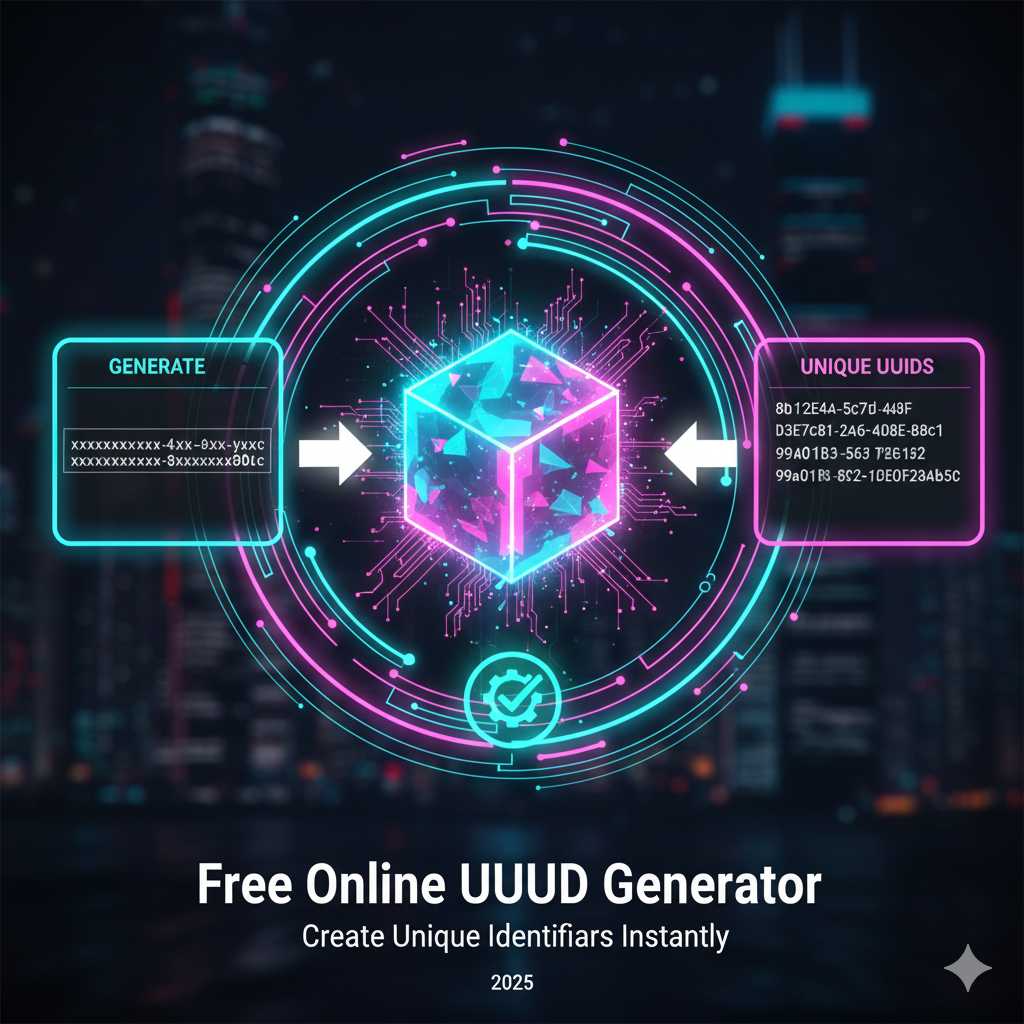
Free Online UUID Generator – Create Unique Identifiers Instantly
Whether you’re a backend engineer designing APIs, a mobile developer managing session IDs, or a database architect ensuring unique primary keys, generating reliable unique identifiers is a daily task. UUIDs (Universally Unique Identifiers) are the standard solution for this. With the UUID Generator by KnowAdvance, you can instantly create UUIDs online — fast, secure, and free.
What Is a UUID?
A UUID (Universally Unique Identifier) is a 128-bit number used to uniquely identify information across systems. It’s represented as a 36-character string, such as:
550e8400-e29b-41d4-a716-446655440000
Because of its large size (2128 possible values), a UUID is practically guaranteed to be unique across space and time, without needing a central authority or database check. This makes UUIDs ideal for distributed systems, APIs, IoT, blockchain projects, and data synchronization.
How UUIDs Work
Each UUID is composed of hexadecimal digits arranged in five groups separated by hyphens (8-4-4-4-12). The bits encode information such as version, variant, timestamp or randomness, depending on which version you use. Common versions include:
- UUID v1 — Generated using the current timestamp and the MAC address of the computer. Ensures uniqueness but can leak hardware information.
- UUID v4 — Generated entirely from random or pseudo-random numbers. It’s the most popular for modern applications because it avoids revealing system details.
- UUID v5 — Generated from a namespace and a name using SHA-1 hashing. Great for deterministic unique IDs based on input values.
Why Use a UUID Generator?
When you need to quickly create unique identifiers, manually coding them or using command-line tools can slow you down. The online UUID Generator on KnowAdvance provides a quick, browser-based way to produce unlimited UUIDs instantly. Use it for:
- Database primary keys or unique columns.
- Generating unique file names for uploads.
- Session IDs or temporary tokens.
- Tracking unique users or events.
- API keys and authentication tokens (with extra encryption).
- Testing software components that require distinct identifiers.
How to Use the KnowAdvance UUID Generator
- Go to UUID Generator.
- Select the UUID version you want (Version 1 or Version 4).
- Choose the number of UUIDs you want to generate (e.g., 1 – 100).
- Click “Generate.” Instantly, you’ll see a list of new unique IDs.
- Copy them to your clipboard or download as a text file.
All operations happen instantly in your browser for speed and privacy — no data ever leaves your device.
Advantages of UUIDs Over Auto-Increment IDs
- No central coordination: Unlike auto-increment IDs, UUIDs can be created independently on multiple servers without collision.
- Better for distributed systems: Microservices or cloud applications can create IDs autonomously without depending on a central database counter.
- Enhanced security through unpredictability: UUID v4 is random enough to make it hard to guess valid IDs, helping prevent scraping or enumeration attacks.
- Globally unique: Even if you merge datasets from different systems, UUID collisions are practically impossible.
- Cross-platform: UUIDs are recognized across all major programming languages and frameworks — Java, Python, Node.js, PHP, Go, and more.
Code Examples for Developers
Generate UUIDs in JavaScript
import { v4 as uuidv4 } from 'uuid';
console.log(uuidv4());
Generate UUIDs in Python
import uuid
print(uuid.uuid4())
Generate UUIDs in PHP
<?php
echo bin2hex(random_bytes(16));
?>
Even if you can create UUIDs in code, using an online generator like KnowAdvance’s is convenient for quick manual generation, testing, and sharing with team members.
Security and Privacy Considerations
While UUIDs are not inherently secret, they are safe for general use in most systems. However, here are a few tips:
- Use UUID v4 for random generation instead of predictable v1.
- Never rely on UUIDs alone for authentication or authorization.
- When generating sensitive tokens, always combine UUIDs with cryptographic random values or hashes.
- Be aware that UUID v1 includes your device’s MAC address and timestamp — avoid it if privacy is a concern.
UUID Structure Explained
A UUID string looks random, but it follows a clear structure. For example:
550e8400-e29b-41d4-a716-446655440000
- 550e8400-e29b — timestamp and clock sequence.
- 41d4 — version and variant bits.
- a716 — node or random bits.
- 446655440000 — remaining random bits.
This structure ensures high uniqueness probability — the chance of two random UUIDs colliding is roughly 1 in 1038.
Common Applications of UUIDs
- Databases: Many modern systems like PostgreSQL, MySQL, and MongoDB natively support UUIDs as primary keys.
- File systems: UUIDs are used to label storage volumes and partitions (especially in Linux and Android systems).
- IoT devices: Assigning UUIDs to each device ensures globally unique identification across networks.
- Software licensing: UUIDs are often used as unique keys for validating licenses or activation codes.
- Testing environments: Developers can create unique test cases and sample data without duplication.
Related Tools on KnowAdvance
- Hash Generator — Generate SHA-256 or MD5 hashes for data integrity.
- Base Converter — Convert numbers between binary, decimal, octal, and hexadecimal.
- Password Generator — Create secure, random passwords using customizable rules.
- JSON Formatter — Format and beautify JSON output from APIs or config files.
Why Choose the KnowAdvance UUID Generator
- Fast and reliable: Generates multiple UUIDs instantly, even for large batches.
- Privacy-first: All generation happens client-side — no data is uploaded or stored.
- Supports multiple versions: Choose between UUID v1 and v4 according to your needs.
- Simple, responsive UI: Works smoothly on desktops, tablets, and smartphones.
- Completely free: No sign-up or usage limits.
Best Practices When Using UUIDs
- When storing UUIDs in databases, use `CHAR(36)` or binary format for efficiency.
- Use lowercase UUIDs for consistency across systems.
- For sorting or indexing, consider sequential UUIDs if supported by your database.
- When exchanging data via API, validate UUID format with regex before processing.
Final Thoughts
UUIDs are one of the simplest yet most powerful tools in modern software design. They enable seamless integration across distributed systems without duplication or collisions. Whether you’re building microservices, setting up IoT infrastructure, or designing databases, the UUID Generator by KnowAdvance saves time, eliminates manual errors, and provides globally unique identifiers on demand.
Try it now — generate your first UUID in one click with KnowAdvance UUID Generator.