Free Online Markdown to HTML Converter – Transform Markdown into Clean Web-Ready HTML
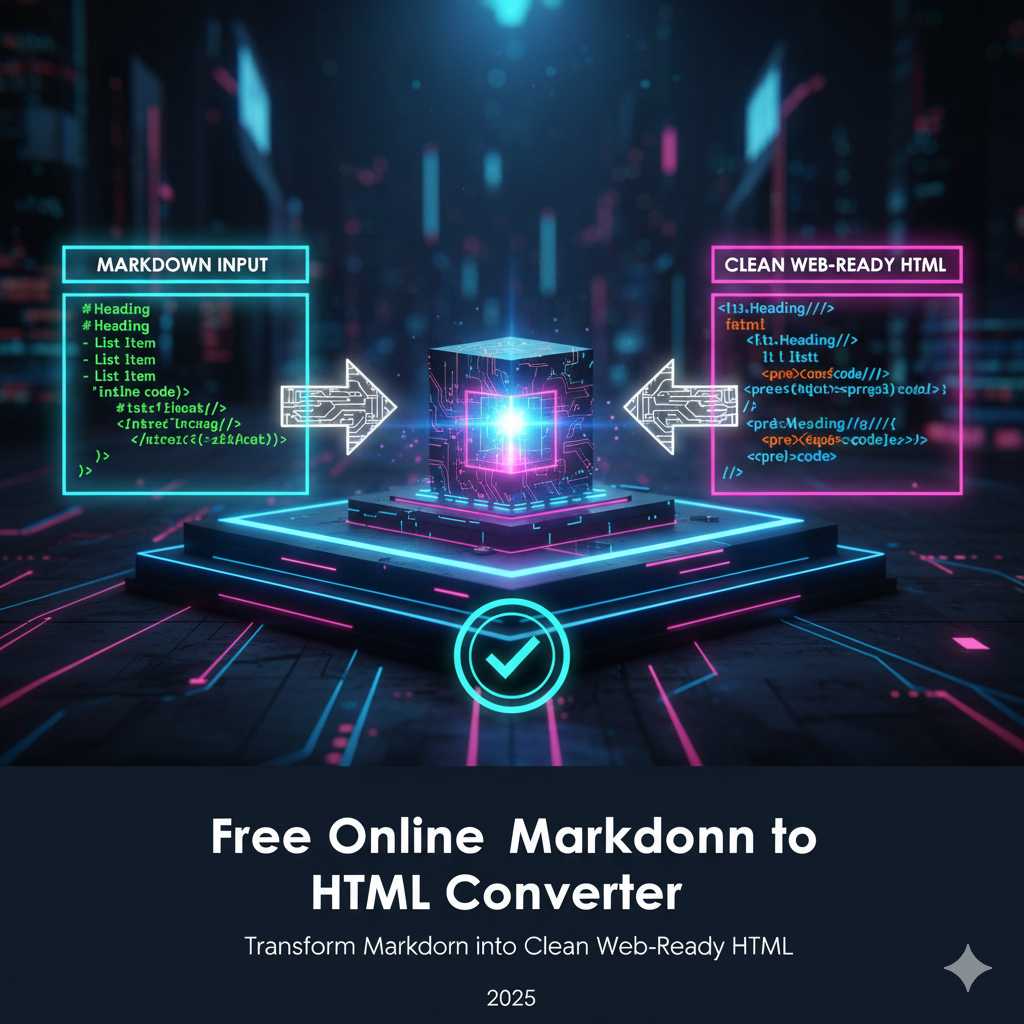
Free Online Markdown to HTML Converter – Transform Markdown into Web-Ready HTML
If you write in Markdown — for blogs, documentation, README files or note-taking — you’ve probably encountered the need to convert that clean, readable syntax into HTML so it can be published on the web. That’s exactly what our Markdown to HTML Converter offers: a fast, free, no-signup tool to turn your Markdown into semantic HTML in seconds.
What is Markdown and Why Convert to HTML?
Markdown is a lightweight markup language that allows you to write using plain-text formatting syntax (for example, `# Heading`, `**bold**`, `> blockquote`, `- list item`). It was designed to be easy to read and write. :contentReference[oaicite:1]{index=1} However, web browsers and websites typically require HTML to render content. Converting your Markdown into HTML bridges the gap between writing and publishing.
Using Markdown has many advantages: faster writing, clean syntax, less distraction, and markdown files are often easier to manage (especially in version control). But when you’re ready to publish content on a web page, blog or documentation site, HTML is the format that browsers understand. That’s why conversion is necessary. As one tool puts it: “writing in Markdown is fast and distraction-free; converting to HTML prepares your content for the web.” :contentReference[oaicite:2]{index=2}
Key Features of Our Markdown to HTML Converter
- Paste or upload Markdown: Drop your `.md` file or paste the Markdown content directly.
- Instant conversion: The tool quickly generates clean, standards-compliant HTML output. :contentReference[oaicite:3]{index=3}
- Copy or download: Once converted, you can copy the HTML or download it as a file.
- No signup required: Use it immediately, no account needed — ideal for quick conversions.
- Wide syntax support: Supports headings, links, images, lists, code blocks and more (depending on the Markdown flavor). :contentReference[oaicite:4]{index=4}
How to Use the Markdown to HTML Converter – Step by Step
- Go to the Markdown to HTML Converter page on KnowAdvance.
- Paste your Markdown text (or upload a `.md` file if available).
- Click the **Convert** (or similar) button.
- The HTML output appears almost instantly.
- Copy the HTML or download it; then paste it into your website, blog editor, or static site generator.
Practical Use Cases for Markdown to HTML Conversion
This tool is useful in many scenarios:
- Blogging & Content Publishing: You may write posts in Markdown (especially if you prefer distraction-free writing), then convert to HTML to publish them. Many content creators follow this workflow.
- Documentation & README Files: Developers often write docs in Markdown (because it’s easy and version-control friendly) but need HTML for website documentation portals. :contentReference[oaicite:5]{index=5}
- Static Site Generators & Editors: Tools like Jekyll, Hugo or Gatsby support Markdown input but ultimately output HTML — converting Markdown manually may still be needed in some cases.
- Note-taking & Knowledge Bases: If you keep notes in Markdown (Obsidian, VS Code, etc.) and want to publish or share them on the web, converting to HTML is a quick step.
Troubleshooting: Why Output Might Not Be Exactly What You Expect
If your converted HTML seems off, check for these common issues:
- Your Markdown may contain custom syntax or extensions not handled by the converter — some tools only support the core syntax. :contentReference[oaicite:6]{index=6}
- Images or links may use improper formatting (e.g., missing alt text or malformed URL) and thus convert incorrectly.
- Your Markdown may have nested or complex structures (tables, nested lists) which some converters struggle with or simplify. :contentReference[oaicite:7]{index=7}
- The resulting HTML may preserve tags or attributes you don’t want — after conversion you may want to clean or adjust the HTML manually.
Tips & Best Practices for Markdown → HTML Conversion
- Write clean Markdown first: Use correct syntax, avoid inline HTML if possible, and preview your Markdown in a Markdown editor before converting.
- Keep styling separate: Markdown focuses on content structure — styling (CSS) should be applied later in the HTML or through external stylesheets.
- Review the HTML result: After conversion, inspect the output HTML for correct tags, clean markup and accessibility features (alt text, semantic tags).
- Use the converter in your workflow: If you often convert, make this tool part of your content pipeline (e.g., write in Markdown, convert, then publish). This improves efficiency and consistency.
Why Choose Our Markdown to HTML Converter on KnowAdvance?
At KnowAdvance we build free, fast, and user-friendly web tools that serve developers, writers, bloggers and non-technical users alike. Here’s why this converter stands out:
- Free and instant: No hidden fees, no login required — start converting immediately.
- Clean UI: The interface is simple and focused on conversion, with minimal distractions.
- Focused on performance: Browser-based and lightweight, optimized for fast conversions.
- Part of a full tool ecosystem: After converting Markdown to HTML you might also use our HTML/CSS/JS Minifier, or our URL Shortener, thereby keeping your workflow within KnowAdvance for multiple tasks.
Related Tools You Might Find Useful
- HTML to Markdown Converter — reverse the process if you have HTML and want to work in Markdown.
- HTML/CSS/JS Minifier — once you have HTML output, you can minify it to improve performance.
- URL Shortener — if your HTML includes long URLs, shorten them before publishing.
Final Thoughts
Markdown is one of the most efficient ways to write content. But when it comes to publishing or embedding content on the web, HTML is the lingua franca. Converting Markdown to HTML shouldn’t be a hassle — it should be a smooth, quick step. With the free Markdown to HTML Converter at KnowAdvance, you get exactly that: a clean, fast and reliable tool to bridge your writing and publishing workflows.
Try it now → Markdown to HTML Converter