Free Online Hash Generator – Instantly Create MD5, SHA-256 & More
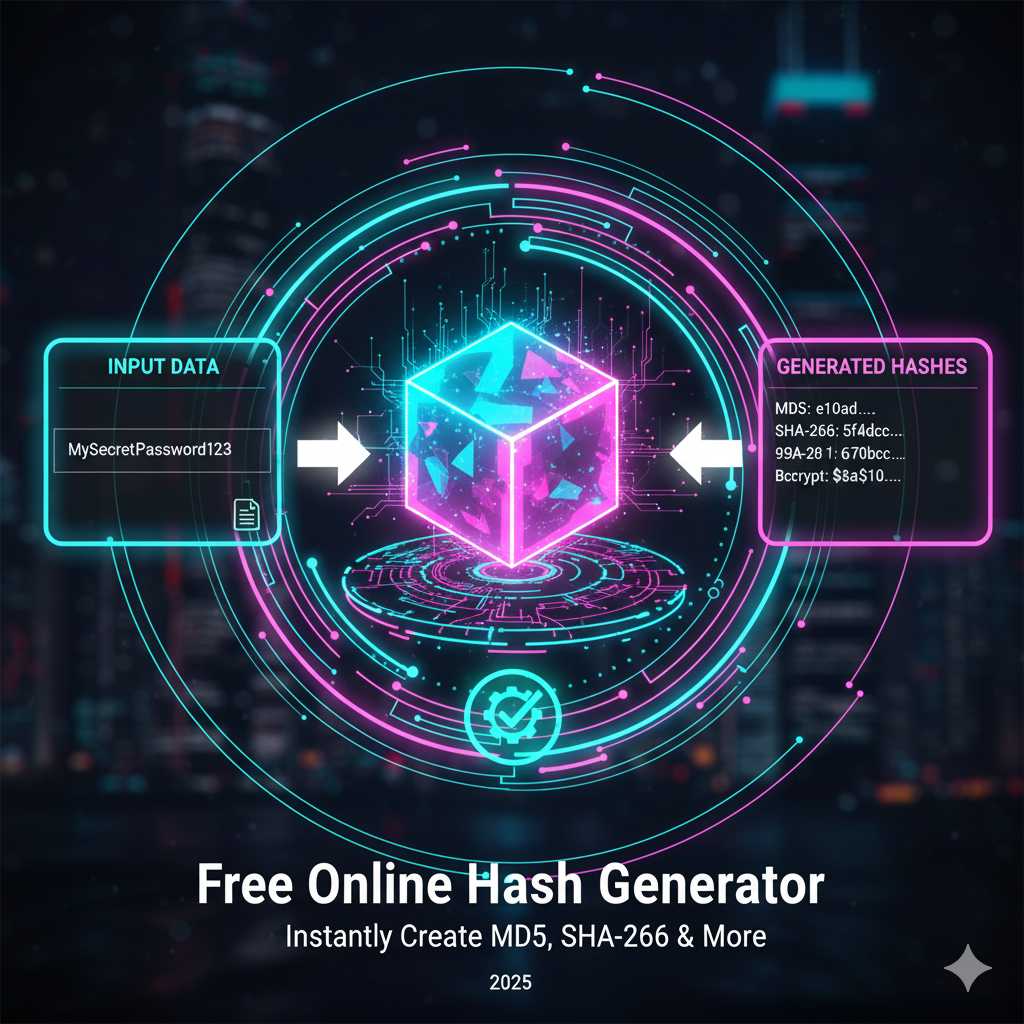
Free Online Hash Generator – Instantly Create MD5, SHA-256 & More
Whether you’re a developer, security tester, or content creator working with data integrity, authentication or file verification, you’ll know that hash functions play a critical role. Now you can use our Hash Generator tool on KnowAdvance to generate cryptographic hashes — quickly, reliably and for free.
What Is a Hash Generator and Why You Need One
A hash generator is a tool that takes text (or often file input) and applies a hash algorithm to output a fixed-length string (often called a digest or hash value). It’s one-way: you can’t (practically) convert the hash back to the original text. Hashes are used in a wide range of use-cases: password storage, file integrity checks, digital signatures, API authentication, blockchain, and more. :contentReference[oaicite:1]{index=1}
For example: if you input the word "password123" into a hash generator with algorithm MD5, you’ll get something like 482c811da5d5b4bc6d497ffa98491e38 — the same input always produces the same output, but a single character change results in a completely different hash. This “avalanche effect” makes hashes ideal for detecting changes and verifying data. :contentReference[oaicite:2]{index=2}
Key Hash Algorithms Supported by Our Tool
Here are some of the most widely used hash algorithms — your hash generator supports many of them:
- MD5 — 128-bit output (32 hex characters). Once widely used, now considered insecure for many security use-cases due to collisions. :contentReference[oaicite:3]{index=3}
- SHA-1 — 160-bit output (40 hex chars). Legacy but still in use in older systems. Less secure than SHA-2/3 families. :contentReference[oaicite:4]{index=4}
- SHA-256 — Part of the SHA-2 family. Very widely used and recommended for modern hashing needs (e.g., file checksums, blockchain, certificates). :contentReference[oaicite:5]{index=5}
- SHA-512 — Larger output, greater security margin, slower but useful when high strength is needed. :contentReference[oaicite:6]{index=6}
- Others: RIPEMD, Whirlpool, SHA-3, etc. Some tools support many algorithms beyond the usual. :contentReference[oaicite:7]{index=7}
How to Use the Hash Generator Tool – Step by Step
- Navigate to the Hash Generator page on KnowAdvance.
- Paste or type the text you want to hash (for example a password, sentence, filename, or data string).
- Select the algorithm you want (e.g., MD5, SHA-256, SHA-512).
- Click the “Generate Hash” button (or equivalent). The tool will compute the hash immediately.
- Copy the resulting hash value, or download/export it if your workflow needs it.
- Optionally verify or compare if you have another hash (many tools offer compare). For file integrity, you might hash the file and compare with a published hash.
Common Use Cases Where Hash Generators Matter
Here are some real-world scenarios:
- Password storage & verification: When storing user passwords, you should never store plain text. Hashing (with a salt) helps protect them. A quick hash generator is handy for testing or demonstrating. :contentReference[oaicite:8]{index=8}
- File integrity and verification: If you download a file from the internet, the publisher often provides a SHA-256 or MD5 checksum. You can hash the file and ensure your download matches—so you know it’s unmodified. :contentReference[oaicite:9]{index=9}
- API authentication & digital signatures: Many integrations use hash functions or HMAC (hash-based message authentication) to verify data authenticity. A hash generator helps you experiment and debug these. :contentReference[oaicite:10]{index=10}
- Blockchain & crypto: Technologies like Bitcoin use SHA-256 hashing heavily; hash generators help developers understand or test these systems. :contentReference[oaicite:11]{index=11}
- Data deduplication & monitoring: Hashes can represent large data blocks. If two blocks give the same hash, they are likely identical—useful in storage systems or for detecting duplicates. :contentReference[oaicite:12]{index=12}
Troubleshooting & Important Considerations
Using a hash generator is simple, but here are some things to keep in mind:
- Hashing is one-way: You cannot reverse a cryptographic hash to get the original data (unless it was weak and guessable). Relying on reversing a hash is insecure. :contentReference[oaicite:13]{index=13}
- Algorithm choice matters: Using MD5 or SHA-1 for security-critical tasks is risky—they are considered broken or weakened. Choose SHA-256, SHA-512 or better. :contentReference[oaicite:14]{index=14}
- Use of salt (for passwords): Simply hashing the password may not be enough—adding random salt prevents precomputed attacks. Though the online tool is good for test data, production systems must do more. :contentReference[oaicite:15]{index=15}
- File size & performance: If hashing a very large file, ensure the tool supports uploads and large size. Some online tools limit size. :contentReference[oaicite:16]{index=16}
- Data privacy: Ensure the tool you use does hashing locally (in browser) or doesn’t send your plain-text input to a server you don’t trust. Good tools emphasise “processing happens in browser” or “data never leaves your device”. :contentReference[oaicite:17]{index=17}
Tips & Best Practices for Using Hash Generators for Maximum Value
- Use the right algorithm for the right purpose: For integrity checks, SHA-256 is excellent. For password hashing, use dedicated algorithms (bcrypt, scrypt) rather than just a plain hash generator tool.
- Keep algorithm versions updated: What’s secure today may be deprecated tomorrow—keep an eye on cryptographic news and best practices.
- Use hash generator tool for learning and testing: It’s great for exploring how hash functions work, teaching or demonstrating. But for production you’ll implement in your stack.
- Verify file integrity often: Use hash generator after transfers/downloads to ensure no corruption or tampering happened. Many software distributions publish a hash for that reason. :contentReference[oaicite:18]{index=18}
- Test different inputs: If you change even one character, the hash changes entirely—this is a good test for the tool’s correctness and your understanding of hashing. :contentReference[oaicite:19]{index=19}
Why Use Our Hash Generator on KnowAdvance?
At KnowAdvance we aim to give you reliable, free tools that solve real problems. Here’s why our Hash Generator stands out:
- Instant, browser-based hashing: You don’t need to install anything. The tool runs fast and simple in your browser.
- Multiple algorithms support: Whether you need MD5, SHA-256, SHA-512 or more, you can choose the one you need.
- No signup, no cost: Use the tool immediately — perfect for developers, students or anyone needing quick hashing.
- Privacy-conscious: Processing happens in your device (for most tools) and your input text isn’t sent to unfamiliar servers.
- Part of a broader ecosystem: After generating a hash, you can use other KnowAdvance tools like JSON Formatter, Hash Generator or URL Shortener in the same workflow.
Related Tools You Might Find Useful
- MD5 Hash Generator — Focus strictly on MD5 algorithm if you need legacy hashing or compatibility checks.
- SHA256 Hash Generator — Dedicated for SHA-256 hashing, often used for file integrity and crypto workflows.
- HMAC SHA256 Generator — If you need keyed hash for message authentication rather than simple hashing.
Final Thoughts
Hashing is at the heart of modern digital security, data integrity and development workflows. Whether you’re verifying a download, testing an API, checking file hashes or simply experimenting with how hash algorithms behave, the Hash Generator by KnowAdvance gives you a fast, free and trustworthy tool to get the job done.
Generate your hash now → Hash Generator